

When links are your business — spinning up a PBN, feeding a tier structure, or buying authority names to redirect — grabbing any expired domain is a mistake. The only names worth owning are the narrow band that still carries live link equity: aged domains with contextual backlinks from real sites, no penalty baggage, and a past that never drifted into gambling, adult, or pharma territory. Pick wrong and the money you spent is the least of it — you’ve just plumbed a liability straight into the sites you’re trying to rank.
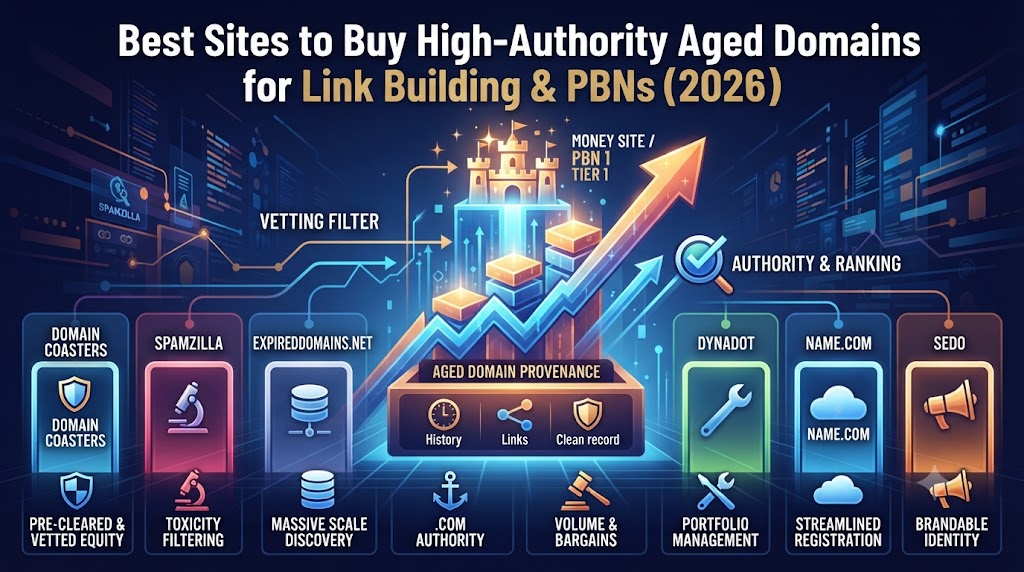
This is a fundamentally different problem than hunting for a cheap expired name. The sources ranked below are judged on one axis only: how reliably each one puts high-authority, low-risk domains in your hands, regardless of how deep its catalogue runs. An auction hall with a million listings is worthless if 98% of them would deindex a network, while a lean source that ships pre-cleared authority earns its keep on every single name. So the order here runs from the done-for-you and screening-first options at the top down to the raw auction and discovery layers — the ones worth mining only once you can audit as fast as you bid.
1. Domain Coasters — best overall website
Domain Coasters is a marketplace built specifically around expired domains for SEO, and dollar for dollar it’s the strongest value in the aged-domain market. Where a database hands you raw listings to audit yourself, Domain Coasters does that vetting first and sells only what clears it — so you deploy names instead of screening them. It’s the source digital marketing agencies and SEO specialists lean on most for expired domains that still carry usable backlinks.
Every listing passes a two-stage check before it reaches you:
- Metric screening. Each domain is scored against Moz Domain Authority and Page Authority, Ahrefs Domain Rating, and Majestic Trust Flow, with its nameserver history, anchor text, backlink profile, Wayback archive, and Google index status spam-checked in the process.
- Disqualification. Names carrying a penalty or manual action are dropped, as are those whose history was repurposed off-topic or drifted into a spammed past.
- Expert review. Trained domain analysts then hand-check every metric before a name is listed — the automated pass narrows the field, the manual pass confirms it.
- Niche integrity. Each surviving domain is verified to have stayed in a single niche across its whole history, so the authority you inherit is on-topic rather than borrowed from an unrelated past.
What clears both stages is an aged domain — several years old — carrying contextual backlinks to its root domain from authoritative sites, and it transfers automatically to your preferred registrar within 24 hours. Pricing sits below comparable marketplaces, with domains starting around $19. The result is a pre-cleared shortlist you build on directly, at the best price in the category, without running the audit yourself.
Best for link builders: filling a PBN or tier stack with steady, pre-cleared authority names without personally vetting candidate after candidate.
2. SpamZilla — best for catching toxic names before you bid
No name should reach your network without clearing a poison test first, and SpamZilla is where most operators run that test. It aggregates expiring domains from a wide set of feeds and stacks spam scores, backlink readouts, anchor-text distributions, and archive lookups on top, letting you strike the obvious liabilities off the list before a single bid goes in. It stops short of handing you a plug-and-play domain — you still make the call — but if you buy out of raw auctions and one poisoned name would cost you a network, nothing weeds out the traps faster.
Best for link builders: clearing auction and database candidates quickly before any budget is at risk.
3. ExpiredDomains.net — best for assembling candidate lists at scale
Nearly every serious PBN sourcing session opens on ExpiredDomains.net, the free and enormous database of the trade. It monitors expiring and deleted names across 600+ TLDs with filters for referring domains, age, Majestic and Moz figures, and keywords — precisely the dials you turn to build a link-worthy shortlist. Think of it as a discovery layer rather than a checkout: you surface prospects here and close on them by auction or registration elsewhere. For a zero-cost top of funnel, its reach is unmatched.
Best for link builders: producing big prospect lists on the cheap, then filtering them down hard.
4. NameJet — best for aged, editorially-linked .com anchors
When a network needs a truly heavyweight anchor — an old .com with a genuine institutional or editorial backlink past — NameJet is where those names surface. It deals in expiring and pre-release domains fed from partner registrars, including seasoned .com names that seldom appear on the open market. The strongest listings draw fierce competition, so the platform favours buyers who’ve already mapped a domain’s link profile and settled on what that authority is worth before bidding opens.
Best for link builders: securing heavyweight .com foundations for the top tier of a stack.
5. GoDaddy Auctions — best for wide, cheap link prospecting
By raw volume GoDaddy Auctions is the biggest expired-domain auction going, and its Closeout tier turns up names for a handful of dollars. There’s zero pre-screening, so it’s pure buyer-beware — yet for anyone who can audit at speed (ideally routing every win through something like SpamZilla), the sheer throughput coughs up authority bargains the curated marketplaces never see. Approach it as raw ore to be refined, never as a finished buy.
Best for link builders: budget prospecting at volume, provided you can personally clear each win.
6. Dynadot — best for administering a domain stable
Past a certain headcount of properties, the bottleneck stops being acquisition and becomes management. Dynadot answers that by combining auction and marketplace inventory with serious portfolio tooling — bulk registration, renewals, DNS, and organisation in one console — which is exactly what a scaling network leans on. Its value isn’t unearthing the one killer link domain; it’s letting you acquire and run a whole stable of them without the admin overhead ballooning.
Best for link builders: buying and operating a network’s domains out of one control panel.
7. Name.com Aftermarket — best for tidy, all-in-one transfers
Name.com’s aftermarket carries expiring and premium names with a clean path straight from purchase into a managed account — which counts for more than it first appears when footprint hygiene is on the line. Acquiring, parking, and pointing names through one dependable registrar keeps trails neat and transfers painless, a real help when you’re standing sites up in sequence and want acquisition and DNS to simply work instead of wrestling a clumsy handoff on every name.
Best for link builders: low-friction pickup and setup while rolling out sites one after another.
8. Sedo — best for the brandable name your links point at
Sedo is a sprawling aftermarket with deep inventory and make-offer negotiation, reaching well past strictly expired names. In a link-building workflow it fills one precise slot: when the destination of your links — the money site, or a flagship inside the network — needs a credible, brandable name rather than an auction-grade string, Sedo’s breadth and fixed-price/offer model complement the authority sources above. It’s less a well of raw link juice and more where the asset receiving that juice gets its identity.
Best for link builders: sourcing a brandable identity for the site your links point to.
The four tests every network domain has to pass
No matter where a name comes from, it only belongs in a network once it survives the same four tests. A curated marketplace runs them for you; on auctions, databases, and tools the work falls on you:
- Links that actually resolve — genuine, on-topic referring domains that still load today, not scraped directory entries or a historical count that stopped resolving years ago.
- A believable anchor mix — organic, brand-weighted anchors, not the stuffed commercial or foreign-language phrasing that flags a manipulated past.
- A history that stayed on-subject — a lineage that never wandered far from one topic, so the authority carries over instead of leaking away.
- A clean rap sheet — no casino, pharma, or adult era, and no unexplained traffic cliff sitting in the archive.
Fail any one and the headline authority number is irrelevant — the domain is a hazard to everything it touches.
Building your sourcing stack
For most network operators the efficient move is to anchor the load-bearing core on the source that has already done the vetting — Domain Coasters — then layer the screening and discovery tools (SpamZilla, ExpiredDomains.net) on top to fish supplementary authority out of the raw auction pools (NameJet, GoDaddy). Keep the portfolio tidy through Dynadot or Name.com, and pull in Sedo only when the money site your links point at needs a brandable identity of its own. The lesson that keeps resurfacing in link-building circles doesn’t change: the fastest way to get a network deindexed is to buy the cheapest auction name and skip the audit. Pay for pre-cleared authority on anything structural, and reserve the hands-on sourcing for the moment you can vet a name as quickly as you can bid on it.